
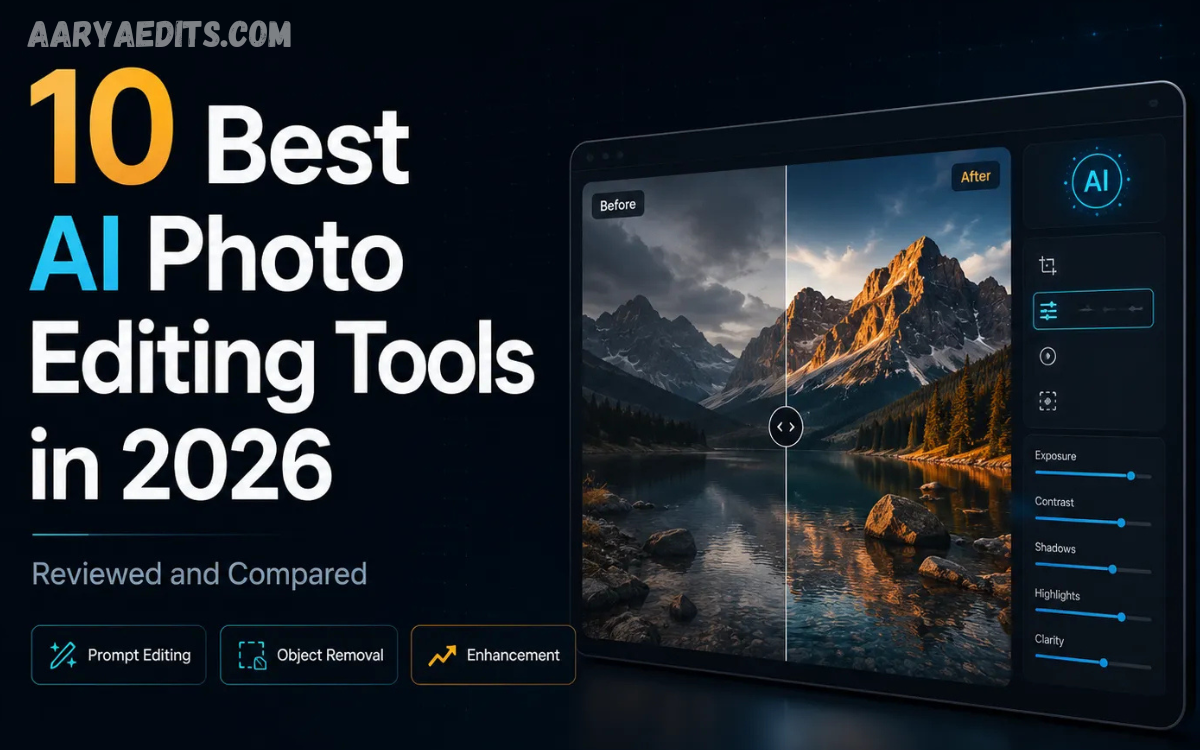
AI image editing has changed significantly in 2026, making professional-looking photo adjustments accessible to beginners, creators, marketers, and designers. I tried more than ten AI image editing tools to understand how they perform with common editing tasks such as background removal, object replacement, image enhancement, retouching, and creative transformations.
During my testing, I focused on practical performance rather than impressive demonstrations alone. I compared how easily each tool handled everyday editing requirements, how much control it provided, and whether the final result looked natural enough for professional use.
Why I Tested AI Image Editing Tools?
The main reason for testing these tools was to understand how much AI can simplify traditional image editing. Tasks that previously required detailed selections, layers, masks, and extensive manual adjustments can now often be completed with a short text instruction or a few clicks.
Another important factor was consistency. An AI editor may produce an impressive result once but struggle with different images, lighting conditions, faces, or complicated backgrounds. Testing multiple tools helped reveal which features worked reliably across different editing situations.
AI Background Removal and Replacement
Background removal was one of the easiest tasks for most AI image editing tools. Modern editors can identify people, products, animals, and other subjects quickly, separating them from complicated backgrounds without requiring manual selection.
Background replacement was more interesting because realistic results require accurate edges and appropriate lighting. The strongest tools were able to place subjects into new environments while maintaining reasonably natural proportions, shadows, and overall composition.
AI Object Removal and Replacement
Object removal is another area where AI image editing has become extremely useful. I tested tools by removing unwanted people, objects, signs, and distractions from photographs to see how well they reconstructed the missing areas.
Results varied depending on the complexity of the background. Simple surfaces were generally reconstructed smoothly, while detailed textures, architectural elements, and crowded scenes sometimes produced noticeable artifacts or repeated patterns.
AI Photo Enhancement and Upscaling
AI enhancement tools are particularly useful when an image is low-resolution, slightly blurry, compressed, or lacking detail. During testing, I used different types of photographs to examine how effectively AI could improve sharpness and overall clarity.
The best results maintained important facial and object details instead of simply increasing artificial sharpness. However, users should still check enhanced images carefully because aggressive AI processing can sometimes create details that were not present in the original photograph.
AI Portrait Retouching
Portrait editing has become one of the most popular applications of AI image technology. I tested automatic skin smoothing, facial enhancement, lighting adjustments, eye enhancement, and other portrait-focused features.
A good AI retouching tool should improve a photograph without making the person look unrealistic. The better editors provided adjustable controls, allowing users to reduce the strength of effects rather than applying an excessive transformation automatically.
AI Image Generation and Creative Editing
Several AI image editors now combine traditional editing with generative features. Instead of simply adjusting an existing photograph, users can describe a new element and ask the editor to integrate it into the image.
This was one of the most impressive areas during my testing. AI can help expand backgrounds, change environments, add objects, and transform visual concepts while preserving parts of the original composition.
AI Editing for Social Media Content
Social media creators can benefit significantly from AI image editing because they often need to produce multiple visual variations quickly. AI tools can resize images, improve compositions, remove backgrounds, create promotional visuals, and prepare content for different platforms.
I found that speed was often more valuable than advanced professional controls for everyday social media work. Tools with simple interfaces and quick automated adjustments made it easier to prepare several images without spending significant time on each one.
AI Image Editing for Product Photos
Product photography is another area where AI tools can save considerable editing time. Background removal, lighting improvements, object cleanup, shadow generation, and composition adjustments can help create cleaner product images.
During testing, I noticed that accuracy is especially important for products with complex shapes, transparent materials, or reflective surfaces. AI can produce useful results, but professional sellers should inspect the final image to ensure that product details have not been changed incorrectly.
AI Image Editing for Graphic Designers
Graphic designers can use AI image editors as productivity assistants rather than complete replacements for traditional editing software. AI can handle repetitive tasks while designers retain control over composition, typography, branding, and final adjustments.
Features such as generative fill, smart selections, automatic masking, and image expansion can reduce the time required for routine work. This allows designers to spend more attention on creative decisions instead of repetitive technical processes.
AI Image Editing for Beginners
One of the biggest advantages I noticed was accessibility. Many AI image editing tools are designed so that users do not need advanced knowledge of layers, masking, or complex editing techniques.
Beginners can often describe what they want in simple language and allow the AI to perform the initial edit. This makes experimentation easier and provides a practical introduction to photo editing without requiring years of software experience.
Comparing AI Editing Accuracy
Accuracy was one of the most important factors in my testing. A useful AI editor should understand the selected area correctly and make changes without unnecessarily modifying unrelated parts of the image.
Different tools performed better for different tasks. Some were stronger at portraits, while others handled backgrounds, object removal, enhancement, or generative editing more effectively. This shows why choosing an AI editor should depend on the specific editing requirement.
Comparing Ease of Use
Interface design can make a major difference in the editing experience. Some tools provide traditional editing panels combined with AI features, while others focus almost entirely on text-based instructions and automated workflows.
I preferred tools that made advanced features easy to discover without hiding essential controls. The ability to undo changes, adjust AI-generated results, and refine a selection was particularly useful during testing.
Comparing Creative Control
Automation is convenient, but creative control remains important for professional editing. I looked at whether the tools allowed users to modify AI results rather than accepting the first generated version.
Editors that offered multiple variations, adjustable settings, masking controls, and regeneration options provided greater flexibility. These features are especially important when an AI-generated result is close to the desired outcome but still needs refinement.
Read Also: Snapseed Editing Techniques: Professional Guide for Better Photo Editing
Common Problems I Found
AI image editing is powerful, but it is not perfect. During testing, some tools struggled with hands, hair, small objects, complex patterns, reflections, and images containing multiple subjects.
Another issue was over-editing. Automatic enhancement can sometimes make photographs look excessively smooth or sharp. For professional work, AI-generated results should therefore be treated as a starting point that may require human review.
How AI Image Editing Has Changed in 2026
The biggest change in 2026 is the growing combination of conventional editing and generative AI. Modern tools increasingly allow users to make changes through natural-language instructions while still providing traditional controls for detailed adjustments.
This combination creates a more flexible workflow. Beginners can rely on automation, while experienced users can refine the results manually. Instead of replacing every editing technique, AI is becoming another layer of the overall creative process.
Choosing the Right AI Image Editing Tool
The right tool depends on what you need to accomplish. Someone creating social media graphics may prioritize speed and templates, while a photographer may care more about realistic retouching and enhancement.
For product photography, background and object controls can be more important. Graphic designers may prefer advanced generative features and precise editing controls. Looking at individual features is therefore more useful than choosing an editor based solely on popularity.
My Experience With 10+ AI Image Editing Tools
After trying more than ten AI image editing tools in 2026, I found that no single editor performed every task perfectly. Each tool had strengths depending on the type of image and the editing objective.
The biggest benefit was the amount of time saved on repetitive work. AI made tasks such as removing backgrounds, cleaning photographs, expanding images, and generating variations considerably more accessible than traditional manual workflows.
Are AI Image Editing Tools Worth Using?
For many users, AI image editing tools are worth exploring because they can reduce editing time and make advanced techniques easier to access. They are particularly useful for everyday photography, social media, marketing, product images, and creative experimentation.
However, AI should not be treated as a guarantee of professional results. Reviewing the output remains important, especially when accuracy, branding, product details, or realistic human features matter.
Tips for Getting Better AI Editing Results
Start with a clear, high-quality source image whenever possible. A well-lit photograph with a clearly visible subject generally gives AI editing systems more information to work with.
Use precise instructions when working with text-based AI editing features. Instead of requesting a vague transformation, describe the subject, desired change, environment, lighting, and areas that should remain unchanged.
What I Learned From Testing AI Image Editors?
The most important lesson from my testing was that AI works best when automation and human creativity are combined. Letting AI handle repetitive tasks can save time, while manual adjustments can correct imperfections and maintain the intended visual style.
I also learned that editing quality depends heavily on the original image. Even advanced AI cannot guarantee perfect results when the source photograph is extremely blurry, poorly exposed, heavily compressed, or visually complicated.
Frequently Asked Questions
What are AI image editing tools?
AI image editing tools use artificial intelligence to automate or assist with tasks such as background removal, object removal, enhancement, retouching, image expansion, and creative transformations.
Can AI edit photos automatically?
Yes, many modern AI editors can automatically detect subjects and apply adjustments based on the user’s instructions. Some also allow users to refine the generated results manually.
Are AI image editors good for beginners?
Yes, many AI image editors are designed for beginners. Automated selections, one-click enhancements, and natural-language editing can make advanced editing tasks easier to understand.
Can AI remove objects from photos?
Yes, object removal is a common AI editing feature. The software analyzes the surrounding area and attempts to reconstruct the background after removing the selected object.
Can AI improve low-quality photos?
AI can improve sharpness, resolution, lighting, and visible details in many low-quality photographs. Results depend on the original image and the technology used by the particular editor.
Can AI replace professional photo editors?
AI can automate many repetitive editing tasks, but professional editors still provide creative direction, detailed corrections, consistency, and quality control that automated tools may not consistently deliver.
Are AI-generated edits always realistic?
No. AI-generated edits can sometimes contain visual errors involving faces, hands, hair, shadows, reflections, textures, or object shapes. Reviewing the final result is important.
Can AI change the background of a photo?
Yes, many AI editors can remove an existing background and replace it with another environment, color, or generated scene.
What should I look for in an AI image editor?
Consider the features you actually need, such as background removal, object replacement, enhancement, retouching, generative editing, manual controls, export options, and ease of use.
Is AI image editing useful in 2026?
AI image editing is increasingly useful in 2026 for photographers, designers, businesses, marketers, creators, and everyday users because it can simplify complex editing tasks and accelerate creative workflows.
Conclusion
My experience with more than ten AI image editing tools in 2026 showed how quickly image editing technology is evolving. AI can simplify background removal, object cleanup, enhancement, portrait retouching, creative transformations, and many other common tasks.
The most practical approach is to use AI as a productivity and creativity tool while maintaining human control over the final result. With careful editing and quality checking, AI image editing can make professional-looking visual content faster and more accessible.
